
Introduction
In recent years, the word “Tensor” has become increasingly common in discussions about Artificial Intelligence (AI), Machine Learning, Deep Learning, and Data Science. Many people encounter terms such as:
- TensorFlow
- Tensor Processing Unit (TPU)
- Tensor Operations
- Tensor Networks
- Tensor Ring Decomposition
Because the term “Tensor” is also used in some alternative healing products, confusion sometimes arises regarding its meaning. In reality, Tensor technology has a well-established scientific and mathematical foundation and plays a critical role in modern AI systems.
This article explains what tensors are, why they are important, and how they contribute to the rapid development of Artificial Intelligence.
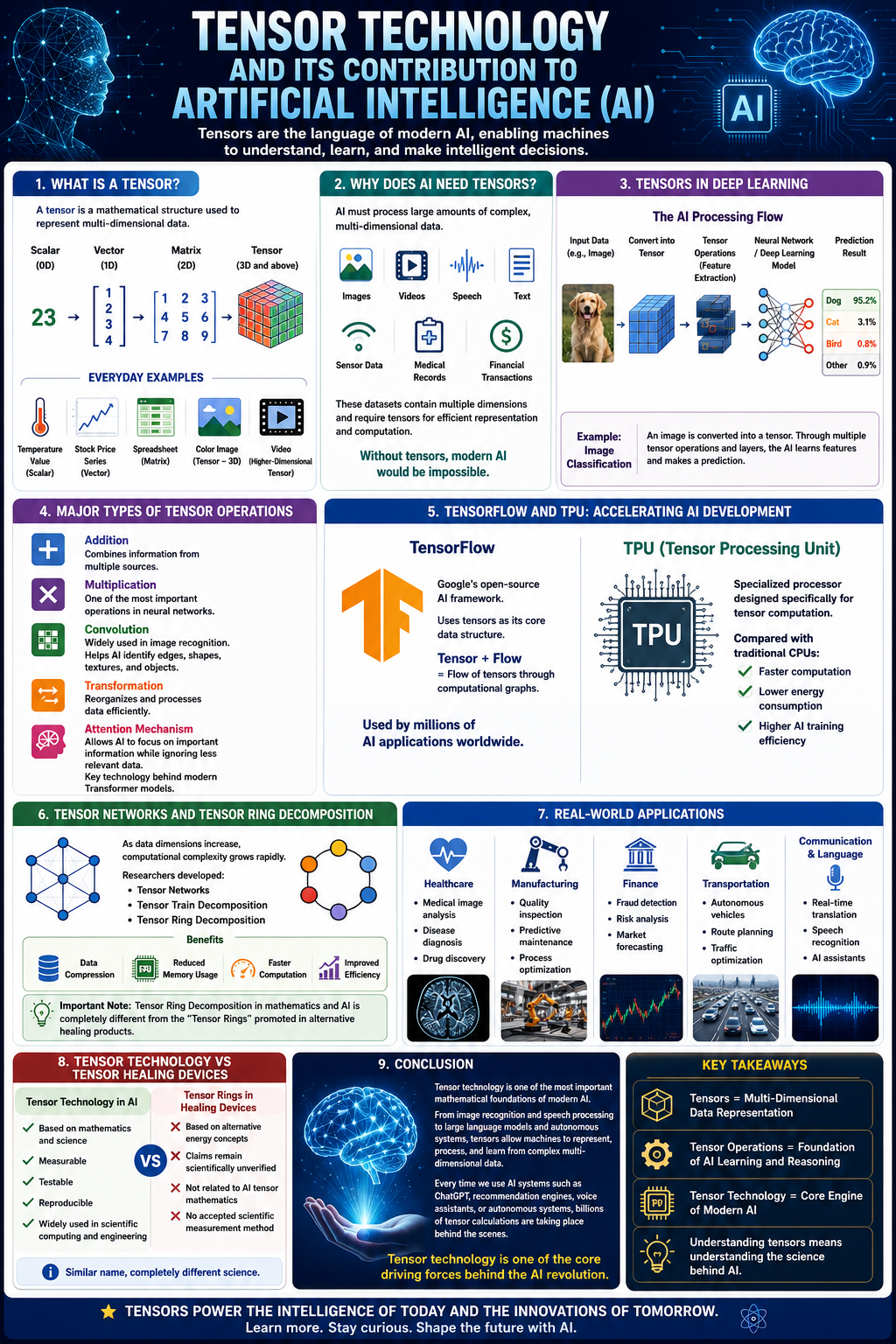
What is a Tensor?
A tensor is a mathematical structure used to represent data in multiple dimensions.
The simplest way to understand tensors is to view them as an extension of numbers, vectors, and matrices.
Examples
| Data Type | Dimension |
|---|---|
| Scalar (single number) | 0-D |
| Vector (list of numbers) | 1-D |
| Matrix (table) | 2-D |
| Tensor | 3-D and above |
Examples:
- A single temperature value = Scalar
- A list of stock prices = Vector
- A spreadsheet = Matrix
- A color image = Tensor
- A video = Higher-dimensional Tensor
In AI, almost all information is ultimately represented as tensors.
Why AI Needs Tensors
Artificial Intelligence deals with enormous amounts of data.
Examples include:
- Images
- Videos
- Speech
- Natural Language
- Sensor Data
- Medical Records
- Financial Transactions
These datasets often contain many dimensions simultaneously.
For example:
A color image may contain:
- Height
- Width
- Color Channels (RGB)
A video may contain:
- Frames
- Height
- Width
- Color Channels
- Time
Representing this information efficiently requires tensors.
Without tensors, modern AI would not be practical.
Tensors in Deep Learning
Deep Learning models consist of large networks of artificial neurons.
Every layer performs mathematical operations on tensors.
A simplified process is:
Input Data → Tensor Operations → Neural Network Layers → Predictions
Examples:
Image Recognition
When an image enters an AI system:
- The image becomes a tensor.
- Tensor calculations extract features.
- Features become patterns.
- Patterns become predictions.
The AI eventually determines:
- Is this a cat?
- Is this a dog?
- Is this a defect in a manufacturing process?
Speech Recognition
Voice assistants such as:
- Siri
- Alexa
- Google Assistant
convert sound waves into tensors.
The AI then processes those tensors to identify:
- Words
- Sentences
- Meaning
Natural Language Processing
Large Language Models (LLMs) such as ChatGPT process language using tensors.
Words are converted into numerical representations called embeddings.
These embeddings become tensors that allow the AI to:
- Understand context
- Generate responses
- Translate languages
- Summarize information
Every conversation with an AI model involves billions of tensor calculations.
Tensor Operations in AI
Some common tensor operations include:
Addition
Combining information from multiple sources.
Multiplication
One of the most important operations in neural networks.
Convolution
Widely used in image recognition.
Convolution helps AI detect:
- Edges
- Shapes
- Patterns
- Objects
Transformation
Used to reorganize and process data efficiently.
Attention Mechanisms
Modern AI models such as Transformers use tensor operations to determine:
- Which information is important
- Which information can be ignored
This innovation helped drive the AI revolution of the last decade.
TensorFlow: A Famous Example
One of the most well-known AI frameworks is:
TensorFlow
Developed by Google, TensorFlow uses tensors as its primary data structure.
The name itself reflects its purpose:
Tensor + Flow
Meaning:
The flow of tensors through computational graphs.
TensorFlow enables developers to build:
- Machine Learning models
- Deep Learning systems
- Computer Vision applications
- Language Models
Millions of AI applications worldwide use TensorFlow.
Tensor Processing Units (TPUs)
As AI models became larger, traditional CPUs became too slow.
Google introduced:
Tensor Processing Units (TPUs)
These specialized processors are designed specifically to perform tensor calculations efficiently.
Compared with traditional processors:
- Faster tensor computation
- Lower energy consumption
- Better AI performance
TPUs significantly accelerated modern AI development.
Tensor Networks and Tensor Ring Decomposition
As AI models continue to grow, computational complexity becomes a challenge.
Researchers developed methods such as:
- Tensor Networks
- Tensor Train Decomposition
- Tensor Ring Decomposition
These techniques help:
- Compress large datasets
- Reduce memory requirements
- Speed up calculations
- Improve efficiency
Tensor Ring Decomposition is especially useful for handling very high-dimensional data.
This is the scientific meaning of “Tensor Ring” in mathematics and AI.
It is completely different from the “Tensor Ring” products promoted in some alternative healing communities.
Why Tensor Technology Matters
Tensor technology provides several key advantages:
Efficient Data Representation
Handles complex multi-dimensional data.
Faster Computation
Optimizes large-scale calculations.
Better AI Performance
Supports more accurate models.
Scalability
Allows AI systems to process increasingly large datasets.
Resource Optimization
Reduces memory and computing requirements.
Real-World Applications
Tensor technology contributes to many AI applications:
Healthcare
- Medical image analysis
- Disease detection
- Drug discovery
Manufacturing
- Quality inspection
- Predictive maintenance
- Process optimization
Finance
- Fraud detection
- Risk analysis
- Market forecasting
Transportation
- Autonomous vehicles
- Traffic optimization
- Route planning
Communication
- Language translation
- Voice recognition
- AI assistants
Conclusion
Tensor technology is one of the most important mathematical foundations of modern Artificial Intelligence. From image recognition and speech processing to large language models and autonomous systems, tensors allow computers to represent, process, and learn from complex multi-dimensional data. Every time we use AI applications such as ChatGPT, image recognition systems, recommendation engines, or voice assistants, tensor calculations are working behind the scenes. While the word “Tensor” is sometimes used in other contexts, its role in AI is well-established, measurable, and supported by decades of mathematical and scientific research.
In simple terms:
Tensors are the language of modern AI. They enable machines to process complex data, learn patterns, and make intelligent decisions, forming one of the essential building blocks of today’s Artificial Intelligence revolution.