如果要停止俄烏戰爭,可能只有俄羅斯總統普京接連出現惡運,無法補救,才會放棄戰爭。
測試集體心念效果,嘗試一齊集氣能令他悔改吧 !

Best practice to manage Information Technology System in Factory and Manufacturing Environment

如果要停止俄烏戰爭,可能只有俄羅斯總統普京接連出現惡運,無法補救,才會放棄戰爭。
測試集體心念效果,嘗試一齊集氣能令他悔改吧 !
The success of Google from a small academic research project in 1998 to one of the most dominant and financially powerful companies in the world by 2026 represents one of the most significant transformations in modern economic history. Unlike many technology companies that began with clear revenue models or strong financial backing, Google’s early years were defined by a focus on solving a fundamental problem: organizing the rapidly expanding information on the internet. At that time, users struggled to find relevant information efficiently, and existing solutions relied heavily on manual curation rather than scalable algorithms.
Google’s founders approached this challenge with a long-term vision centered on building a highly efficient search engine supported by advanced computational infrastructure. Importantly, early products such as search and mapping technologies did not generate meaningful revenue. Instead, they were designed to attract users, improve data collection, and justify investment in large-scale infrastructure. This strategic choice distinguished Google from competitors such as Yahoo, which focused on short-term monetization through portal-based content.
Over time, Google transformed its infrastructure into a powerful economic engine by introducing targeted advertising based on user intent. This shift allowed the company to achieve extraordinary revenue growth and ultimately surpass traditional technology leaders such as Microsoft. This article examines Google’s development from 1998 to 2026, focusing on its financial evolution, leadership, and strategic decisions that enabled it to dominate the global digital economy.
Google’s success is deeply rooted in its leadership:
👉 Key insight:
Google combined deep technical innovation with disciplined execution, which many competitors lacked.
At this time:
👉 This decision allowed Google to grow independently
Google’s early core products:
👉 Critical point:
These products:
Google’s strategy was to:
Google invested heavily in:
👉 This infrastructure enabled:
👉 Key insight:
Google did not start as an advertising company—it started as an infrastructure company
| Year | Revenue |
|---|---|
| 2004 | ~$3.2B |
| 2006 | ~$10.6B |
| 2008 | ~$21.8B |
Google introduced:
👉 Key innovation:
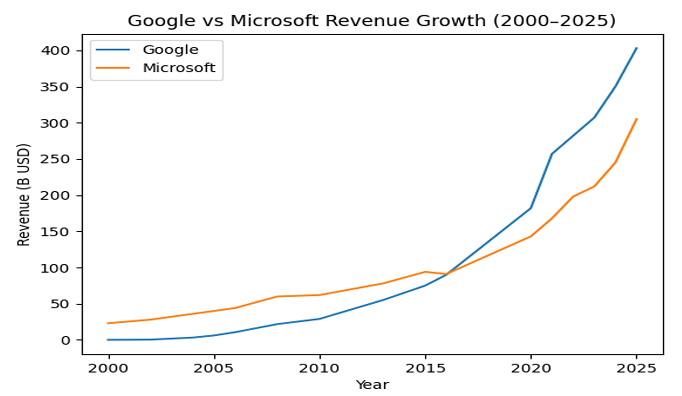
This analyzes the historical growth and future outlook of Google compared to Microsoft. It
highlights how Google’s infrastructure-first strategy enabled it to surpass Microsoft in revenue,
supported by advertising and cloud expansion, while Microsoft leveraged enterprise software and
cloud services.
| Year | Microsoft | |
| 2000 | <$0.1B | ~$23B |
| 2002 | ~$0.4B | ~$28B |
| 2004 | ~$3.2B | ~$36B |
| 2005 | ~$6.1B | ~$40B |
| 2006 | ~$10.6B | ~$44B |
| 2008 | ~$21.8B | ~$60B |
| 2010 | ~$29B | ~$62B |
| 2013 | ~$55B | ~$78B |
| 2015 | ~$75B | ~$94B |
| 2016 | ~$90B | ~$91B |
| 2020 | ~$182B | ~$143B |
| 2021 | ~$257B | $168B |
| 2022 | ~$282B | $198B |
| 2023 | ~$307B | $212B |
| 2024 | ~$350B | $245B |
| 2025 | ~$403B | $305B |
👉 Strategy:
Control user entry points → increase ad opportunities
| 2025 Metric | Microsoft | |
| Revenue | ~$403B | ~$305B |
| Gross Margin | ~59.7% | ~68.6% |
| Operating Margin | ~31.6% | ~47.1% |
| Net Margin | ~32.8% | ~39.0% |
| ROE | ~35.7% | ~34.4% |
| Free Cash Flow | ~$38B | ~$53B |
Google’s financial structure in 2025:
👉 Key insight:
Google continuously reinvests profits into:
| Factor | Yahoo | |
|---|---|---|
| Strategy | Search + infrastructure | Portal/content |
| Monetization | Performance ads | Display ads |
| Outcome | Global dominance | Decline |
👉 Yahoo focused on:
Google focused on:
| Factor | Microsoft | |
|---|---|---|
| Revenue model | Ads | Software + cloud |
| Market | Global users | Enterprises |
| 2025 revenue | ~$403B | ~$282B |
👉 Insight:
Google monetizes:
Microsoft monetizes:
| Year | Revenue |
|---|---|
| 2016 | ~$90B |
| 2020 | ~$182B |
| 2025 | ~$403B |
👉 Google evolves into:
The success of Google from 1998 to 2026 can be understood as the result of a long-term strategic vision that prioritized infrastructure, scalability, and monetization efficiency over short-term financial gains. In its early years, Google deliberately focused on building products such as search and mapping technologies that did not generate immediate revenue. These products were instrumental in attracting users and collecting data, which in turn justified the company’s heavy investment in computational infrastructure. This infrastructure became the foundation upon which Google built its highly successful advertising business.
Unlike competitors such as Yahoo, which pursued a portal-based strategy centered on content and display advertising, Google focused on developing scalable systems capable of delivering highly relevant search results. This technological advantage enabled Google to introduce a new form of advertising based on user intent, significantly improving the effectiveness of online marketing. As a result, Google was able to generate substantial revenue while maintaining high margins, allowing for continuous reinvestment in innovation.
In comparison with Microsoft, Google followed a fundamentally different path. While Microsoft built its business around enterprise software and operating systems, Google focused on monetizing global user activity. This approach allowed Google to achieve a scale that far exceeded that of traditional software companies. Despite having fewer products, Google’s ability to reach billions of users and convert their interactions into revenue enabled it to surpass Microsoft in total revenue.
Financially, Google demonstrated a unique combination of discipline and boldness. The company maintained strong cash flow and relatively low debt while simultaneously investing heavily in new technologies and markets. This balance allowed Google to manage risk effectively while pursuing long-term growth opportunities. By continuously reinvesting in its infrastructure and expanding its ecosystem, Google created a self-reinforcing cycle of growth that has sustained its competitive advantage for over two decades.
In conclusion, Google’s success illustrates the importance of aligning technological innovation with a scalable and efficient business model. By transforming its infrastructure into a powerful advertising platform, Google not only outperformed its early competitors but also redefined the economics of the internet. As of 2026, its position as a global revenue leader reflects the enduring strength of this strategy and provides valuable lessons for understanding the dynamics of modern digital markets.
Please refer to the following BBC news about the Hu JinTao was dramatically led out of a session during last week’s Communist Party Congress in Beijing -> Hu Jintao: Fresh China congress footage deepens mystery over exit – BBC News
It is sad that Nowadays becomes a new page to China PRC, most probably it is a turning point to dark and isolate. On behalf of a Chinese like me, I am regret about this situation.

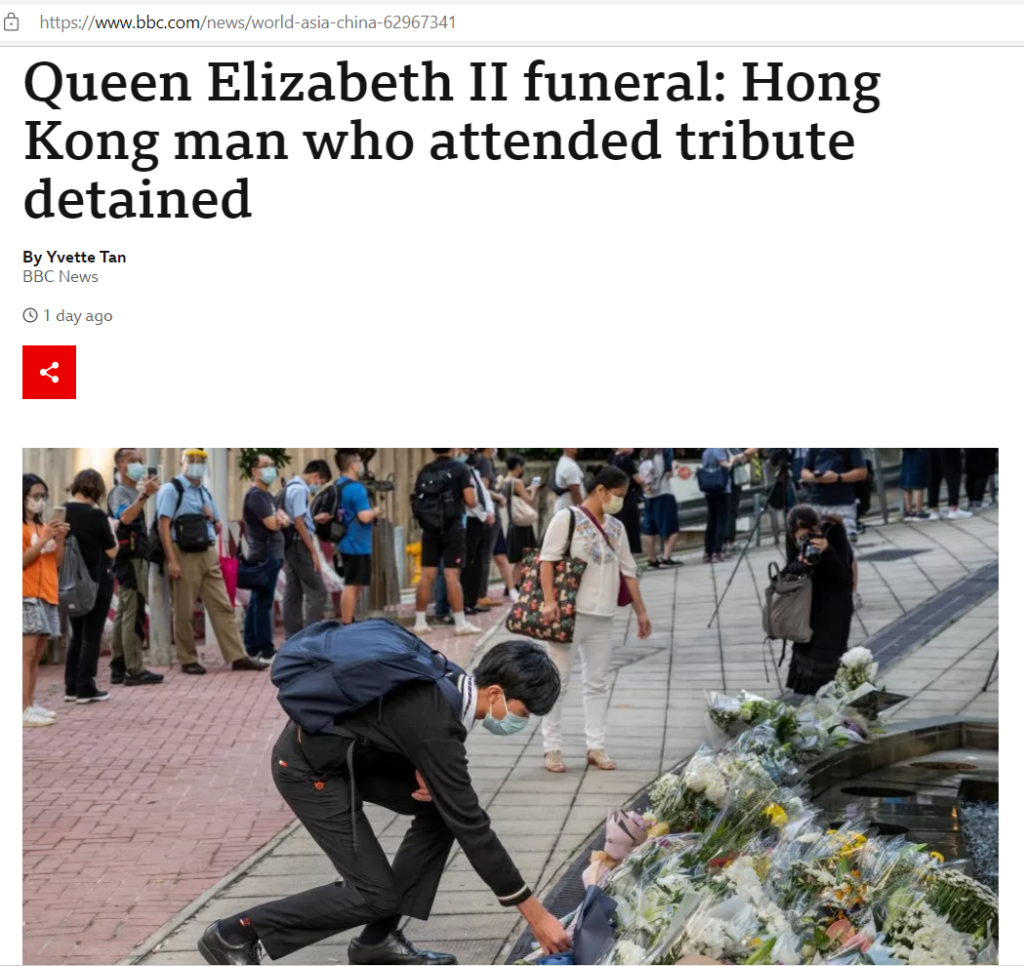
It is really improbably action to detain a Hong Kong man who went to the British consulate on Monday night to pay tribute to Queen Elizabeth II, among scores of mourners. Shame on that action.

Hiring Production Operatives – food production! FREE transport from Leeds!
Interested? Get in touch with us today
Call on: +44 07843 800967 or PM Aleks +44 07597521411
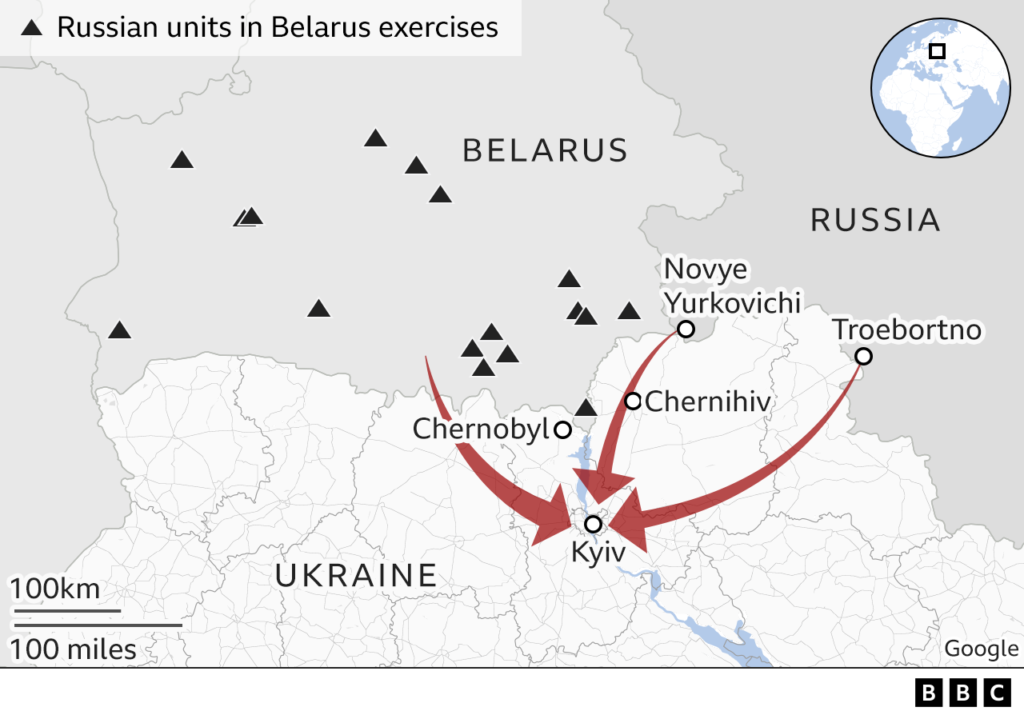
Although President Zelensky warned Russia that they would defend, Russia still invaded Ukraine on 24 Mar 2022. It may be a starting point of the third world war. President Vladimir Putin is the big evil of human being; he is too selfish only with mind of invasion and violation. Human False repeats which peace and war appear again and again. Ultimately in worst case, our world destroy (and then rebuild). Putin is absolutely an invader. No one can learn from history.
No key person is willing to stop evil nowadays, our world is in risk. As a common person like us, nothing we can really help. Let’s pray for Ukraine; and also pray that China will not invade Taiwan.
Reference: BBC news about Ukraine -> https://www.bbc.com/news/world-europe-60497510
Most Critical Software for CAD: 3dsmax, autocad, revit, unreal, sketchup
Critical software function: loft, sweep, revolve, extrud
Importation person: Alex roman
3dcad.com
viz4d.com
bimobject.com
indiegogo.com
3dwarehouse.sketchup.com
apps.autodesk.com/en
3d printing – .stl – 3d printing file format
www.dimensions.com
viewer.autodesk.com – shape of file for view & comment for edit
web.autocad.com
1001fonts.com
dafont.com
3dsmax plugin (corcona, vray)
3d66.com
viz4d.com
datasmith (output of VR file format)
= pi()
sum(), AVERAGE(), max(), min(), count(), counta()
countif(), sumif(), averageif(), ountifs(), sumifs(), averageifs()
today(), now(), time(), workday(), date(year, month,day), edate(start_date, months)
upper(), lower(), proper(), left(), right(), mid(), len(), trim(), search()
vlookup(), hlookup()
旅遊航空拍攝
土地規劃
實景堪察
工程建築
工程進度
巡邏監控
搜索救援
送貨
宴會婚禮製作
無人機編隊表演
速無人機
(Drones Application of Aerial Photography)