
1. Introduction
The success of Google from a small academic research project in 1998 to one of the most dominant and financially powerful companies in the world by 2026 represents one of the most significant transformations in modern economic history. Unlike many technology companies that began with clear revenue models or strong financial backing, Google’s early years were defined by a focus on solving a fundamental problem: organizing the rapidly expanding information on the internet. At that time, users struggled to find relevant information efficiently, and existing solutions relied heavily on manual curation rather than scalable algorithms.
Google’s founders approached this challenge with a long-term vision centered on building a highly efficient search engine supported by advanced computational infrastructure. Importantly, early products such as search and mapping technologies did not generate meaningful revenue. Instead, they were designed to attract users, improve data collection, and justify investment in large-scale infrastructure. This strategic choice distinguished Google from competitors such as Yahoo, which focused on short-term monetization through portal-based content.
Over time, Google transformed its infrastructure into a powerful economic engine by introducing targeted advertising based on user intent. This shift allowed the company to achieve extraordinary revenue growth and ultimately surpass traditional technology leaders such as Microsoft. This article examines Google’s development from 1998 to 2026, focusing on its financial evolution, leadership, and strategic decisions that enabled it to dominate the global digital economy.
2. Founders and Leadership: Technology-Driven Vision
Google’s success is deeply rooted in its leadership:
- Larry Page
- Developed the PageRank algorithm
- Focused on scalable system architecture
- Sergey Brin
- Expertise in mathematics and data systems
- Eric Schmidt
- Provided business discipline and scaling strategy
- Sundar Pichai
- Led global products (Chrome, Android) and AI transformation
👉 Key insight:
Google combined deep technical innovation with disciplined execution, which many competitors lacked.
3. Early Stage (1998–2003): Weak Capital, Strong Focus
Funding
- 1998: ~$100K angel investment
- 1999: ~$25M venture capital
At this time:
- Yahoo dominated web traffic
- Microsoft dominated software
Strategic Mistake by Yahoo
- 1998: Google offered for ~$1M → rejected
- 2002: Negotiation failed at $5B
👉 This decision allowed Google to grow independently
4. Core Business Model (Early): Search, Maps, and Infrastructure
Google’s early core products:
- Search engine
- Early mapping technologies (later Google Maps)
👉 Critical point:
These products:
- generated little or no revenue initially
- required significant investment
Why build non-revenue products?
Google’s strategy was to:
- Attract massive user traffic
- Collect user behavior data
- Build large-scale computing infrastructure
5. Infrastructure as the Hidden Foundation
Google invested heavily in:
- Data centers
- Distributed computing
- Fast indexing systems
👉 This infrastructure enabled:
- superior search speed
- better user experience
- scalability across billions of users
👉 Key insight:
Google did not start as an advertising company—it started as an infrastructure company
6. IPO and Monetization Breakthrough (2004–2008)
IPO (2004)
- Raised: $1.67B
- Valuation: ~$23B
Revenue Growth
| Year | Revenue |
|---|---|
| 2004 | ~$3.2B |
| 2006 | ~$10.6B |
| 2008 | ~$21.8B |
Advertising Model
Google introduced:
- AdWords
- AdSense
👉 Key innovation:
- Ads based on user intent
7. Expansion and Platform Strategy (2009–2015)
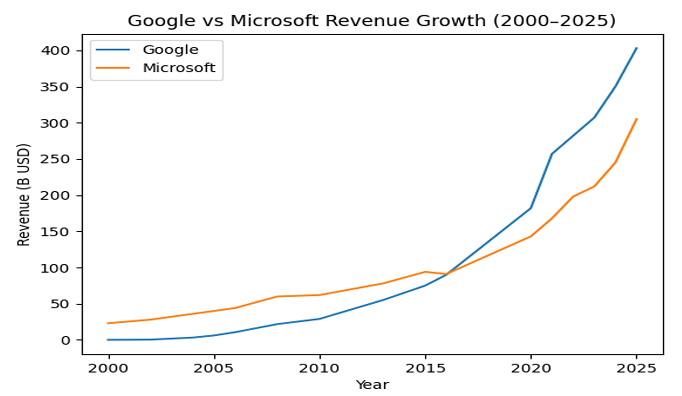
Revenue Growth
This analyzes the historical growth and future outlook of Google compared to Microsoft. It
highlights how Google’s infrastructure-first strategy enabled it to surpass Microsoft in revenue,
supported by advertising and cloud expansion, while Microsoft leveraged enterprise software and
cloud services.
| Year | Microsoft | |
| 2000 | <$0.1B | ~$23B |
| 2002 | ~$0.4B | ~$28B |
| 2004 | ~$3.2B | ~$36B |
| 2005 | ~$6.1B | ~$40B |
| 2006 | ~$10.6B | ~$44B |
| 2008 | ~$21.8B | ~$60B |
| 2010 | ~$29B | ~$62B |
| 2013 | ~$55B | ~$78B |
| 2015 | ~$75B | ~$94B |
| 2016 | ~$90B | ~$91B |
| 2020 | ~$182B | ~$143B |
| 2021 | ~$257B | $168B |
| 2022 | ~$282B | $198B |
| 2023 | ~$307B | $212B |
| 2024 | ~$350B | $245B |
| 2025 | ~$403B | $305B |
Strategic Investments
- Android (mobile OS)
- YouTube (video platform)
- Chrome (browser)
👉 Strategy:
Control user entry points → increase ad opportunities
8. Financial Structure and Cost Model
| 2025 Metric | Microsoft | |
| Revenue | ~$403B | ~$305B |
| Gross Margin | ~59.7% | ~68.6% |
| Operating Margin | ~31.6% | ~47.1% |
| Net Margin | ~32.8% | ~39.0% |
| ROE | ~35.7% | ~34.4% |
| Free Cash Flow | ~$38B | ~$53B |
Google’s financial structure in 2025:
- Cost of revenue: ~40–45%
- R&D: ~15–20%
- Heavy infrastructure spending
2025 Financial Snapshot
- Revenue: ~$403B
- R&D: ~$60B+
- Workforce: ~180,000
👉 Key insight:
Google continuously reinvests profits into:
- infrastructure
- innovation
9. Comparison with Yahoo
| Factor | Yahoo | |
|---|---|---|
| Strategy | Search + infrastructure | Portal/content |
| Monetization | Performance ads | Display ads |
| Outcome | Global dominance | Decline |
👉 Yahoo focused on:
- short-term revenue
Google focused on:
- long-term scalability
10. Comparison with Microsoft
| Factor | Microsoft | |
|---|---|---|
| Revenue model | Ads | Software + cloud |
| Market | Global users | Enterprises |
| 2025 revenue | ~$403B | ~$282B |
👉 Insight:
Google monetizes:
- billions of users
Microsoft monetizes:
- enterprise clients
11. 2016–2026: Scale, Cloud, and AI
Revenue Growth
| Year | Revenue |
|---|---|
| 2016 | ~$90B |
| 2020 | ~$182B |
| 2025 | ~$403B |
Investment Focus
- Cloud computing
- Artificial intelligence
- Data infrastructure
👉 Google evolves into:
- data + AI platform
12. Conclusion
The success of Google from 1998 to 2026 can be understood as the result of a long-term strategic vision that prioritized infrastructure, scalability, and monetization efficiency over short-term financial gains. In its early years, Google deliberately focused on building products such as search and mapping technologies that did not generate immediate revenue. These products were instrumental in attracting users and collecting data, which in turn justified the company’s heavy investment in computational infrastructure. This infrastructure became the foundation upon which Google built its highly successful advertising business.
Unlike competitors such as Yahoo, which pursued a portal-based strategy centered on content and display advertising, Google focused on developing scalable systems capable of delivering highly relevant search results. This technological advantage enabled Google to introduce a new form of advertising based on user intent, significantly improving the effectiveness of online marketing. As a result, Google was able to generate substantial revenue while maintaining high margins, allowing for continuous reinvestment in innovation.
In comparison with Microsoft, Google followed a fundamentally different path. While Microsoft built its business around enterprise software and operating systems, Google focused on monetizing global user activity. This approach allowed Google to achieve a scale that far exceeded that of traditional software companies. Despite having fewer products, Google’s ability to reach billions of users and convert their interactions into revenue enabled it to surpass Microsoft in total revenue.
Financially, Google demonstrated a unique combination of discipline and boldness. The company maintained strong cash flow and relatively low debt while simultaneously investing heavily in new technologies and markets. This balance allowed Google to manage risk effectively while pursuing long-term growth opportunities. By continuously reinvesting in its infrastructure and expanding its ecosystem, Google created a self-reinforcing cycle of growth that has sustained its competitive advantage for over two decades.
In conclusion, Google’s success illustrates the importance of aligning technological innovation with a scalable and efficient business model. By transforming its infrastructure into a powerful advertising platform, Google not only outperformed its early competitors but also redefined the economics of the internet. As of 2026, its position as a global revenue leader reflects the enduring strength of this strategy and provides valuable lessons for understanding the dynamics of modern digital markets.