
1. Introduction
As Google enters the next stage of its evolution, it faces a fundamental transition from a search-driven company to an AI-driven platform. Over the past two decades, Google successfully monetized global user behavior through search-based advertising, building one of the most powerful revenue engines in history. However, the emergence of artificial intelligence is beginning to reshape how users interact with information. Instead of traditional search queries and link-based results, users are increasingly turning to conversational AI systems that provide direct answers.
This shift introduces both opportunity and risk. On one hand, AI enables Google to enhance user experience, improve targeting, and increase monetization efficiency. On the other hand, it may reduce the number of traditional search interactions that generate advertising revenue. At the same time, competition is intensifying. Microsoft is leveraging its enterprise ecosystem to monetize AI through subscriptions, while Amazon continues to dominate cloud infrastructure.
To understand Google’s future position, it is necessary to analyze not only its current financial strength but also its projected growth trajectory. This article presents a structured forecast model for the period 2026–2030, based on analyst consensus data, realistic growth assumptions, and market dynamics in AI and cloud computing.
2. Baseline Forecast
We begin with analyst consensus forecasts, which provide the most reliable near-term outlook.
Revenue Forecast
- 2026: ~$486B
- 2027: ~$561B
- Assumption of Growth: ~15–20% annually
Microsoft
- 2026: ~$335B
- 2027: ~$387B
- Assumption of Growth: ~15–18% annually
Key Observation
👉 Both companies are growing at similar rates
👉 Therefore:
- Microsoft is not catching up quickly
- The revenue gap remains structurally large
👉 Insight:
Even with strong AI growth, Microsoft’s smaller base limits its ability to overtake Google in the short term.
3. Building the 5-Year Projection Model (2026–2030)
To extend beyond analyst forecasts, we construct a forward-looking model using realistic assumptions.
Growth Assumptions
- Google: 14% CAGR (Compound Annual Growth Rate)
- Slight slowdown due to scale
- Offset by AI and cloud growth
- Microsoft: 15% CAGR
- Slightly higher due to AI monetization
- Strong enterprise demand
👉 Why these assumptions?
- Both companies are already very large → growth naturally slows
- AI provides incremental acceleration, not exponential growth
- Cloud remains a major driver
4. Revenue Projection Model
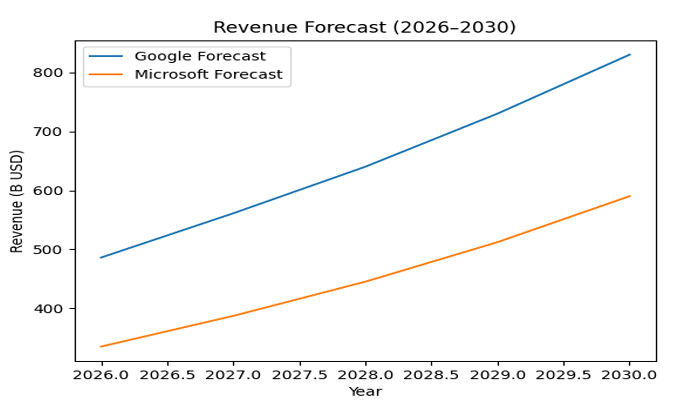
Google has overtaken Microsoft due to its scalable advertising model and global user
reach. Looking forward, AI and cloud computing will determine whether Google can maintain its
lead.
| Year | Microsoft | |
|---|---|---|
| 2026 | 486B | 335B |
| 2027 | 561B | 387B |
| 2028 | 640B | 445B |
| 2029 | 730B | 512B |
| 2030 | 830B | 590B |
Interpretation of Results
👉 Google still leads by ~40%+ revenue
👉 Microsoft does NOT overtake by 2030
👉 Key insight:
Even with slightly faster growth, Microsoft cannot close the gap because:
- Google’s base is significantly larger
- Ads + cloud generate massive cash flow
5. Cloud Market Forecast (Key Battlefield)
Cloud computing is the most important growth driver for all major tech companies.
Current Market Structure (2025–2026)
- Amazon Web Services: ~30–32%
- Microsoft Azure: ~21–26%
- Google Cloud: ~12–15%
Growth Trends
- Google Cloud → fastest growth
- Azure → strongest enterprise adoption
- AWS → largest but maturing
👉 Market expansion:
- ~25%+ annual growth
6. 2030 Cloud Market Forecast (Model)
| Company | Market Share |
|---|---|
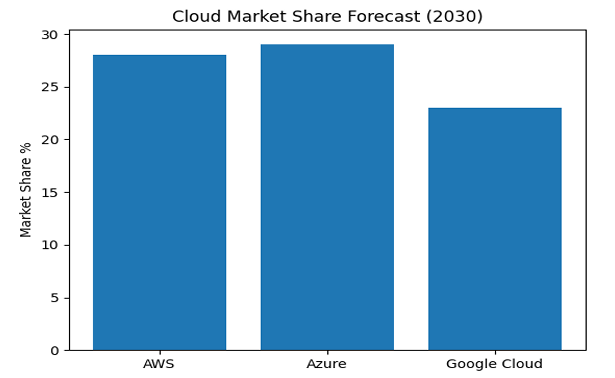
| AWS | ~28% |
| Azure | ~27–30% |
| Google Cloud | ~20–25% |
Interpretation
- AWS remains a major player
- Azure may reach or surpass AWS
- Google Cloud closes the gap significantly
👉 Key insight:
Google Cloud is not the largest—but it is the fastest strategic improver
7. Ads Business: Core Strength vs Structural Risk
Google’s revenue still depends heavily on advertising (~70–80%).
Strength
- High-margin
- Intent-based
- Scalable
Risk
AI may:
- reduce clicks
- reduce impressions
- change user behavior
👉 Core question:
Will AI reduce or enhance advertising revenue?
8. Strategic Scenario Analysis
Scenario 1: Base Case
- Google maintains leadership
- Microsoft grows steadily
Scenario 2: Microsoft Overtakes
- AI replaces search
- Ads decline significantly
Scenario 3: Google Extends Lead (Most Likely)
Conditions:
- AI improves search quality
- Ads become more valuable
- Cloud growth accelerates
👉 Result:
- Google pulls further ahead
- Revenue gap remains large
9. Role of Amazon (Balanced View)
Amazon remains:
- infrastructure leader
- stable ecosystem provider
👉 More realistic outlook:
- slight market share decline
- but no major collapse
10. Critical Turning Point (2026–2028)
The next 2–3 years will determine:
- whether AI disrupts ads
- or strengthens monetization
👉 This is the single most important variable
11. Conclusion (Expanded)
The financial forecast for Google between 2026 and 2030 reflects both its strong current position and the uncertainties associated with technological transformation. Based on analyst consensus data and realistic growth assumptions, Google is expected to maintain its leadership in global revenue, with projected revenue reaching approximately $830 billion by 2030. Microsoft, while demonstrating slightly higher growth rates driven by its enterprise AI strategy, is unlikely to close the gap within this timeframe due to the scale advantage held by Google. The similarity in growth rates between the two companies suggests that their relative positions will remain largely stable, with Google continuing to lead by a significant margin.
The cloud market emerges as a critical battleground in this forecast. While Amazon Web Services is expected to retain a strong position due to its scale and ecosystem, Microsoft Azure is likely to expand its share through enterprise integration, and Google Cloud is projected to achieve the fastest growth, driven by its strengths in artificial intelligence and data processing. By 2030, the cloud market is expected to become more balanced, with all three players holding substantial but differentiated positions.
However, the most important factor influencing Google’s future is the evolution of its advertising business in the context of artificial intelligence. If AI enhances the effectiveness of advertising by improving targeting and user engagement, Google may not only sustain its growth but also increase its revenue efficiency. Conversely, if AI reduces the need for traditional search interactions, the company could face significant challenges in maintaining its current revenue model.
In conclusion, the most probable scenario is that Google will continue to lead the global technology sector over the next five years, supported by its strong financial foundation, extensive infrastructure, and ability to adapt its business model. While competition from Microsoft and Amazon will intensify, the structural advantages that Google has built over the past two decades—particularly in data, scale, and monetization—are likely to ensure its continued dominance, provided it successfully integrates artificial intelligence into its core revenue-generating systems.