
Executive Summary
For decades, Enterprise Resource Planning (ERP) systems such as SAP, Microsoft Dynamics, Oracle, and QAD have served as the backbone of manufacturing and supply chain operations. Material Requirements Planning (MRP) remains one of the most important functions within these systems, enabling organizations to translate demand into procurement and production plans.
As Artificial Intelligence (AI) technologies mature, a common question is emerging: “Can AI replace ERP material planning systems?”
The answer is more nuanced than many technology vendors suggest. While AI offers significant opportunities to improve planning quality, forecast accuracy, inventory optimization, and sourcing decisions, it is unlikely to replace the core deterministic planning and transaction-processing capabilities of ERP systems. Instead, AI is expected to become an intelligent planning layer operating above traditional ERP platforms, augmenting human decision-making and improving supply chain performance.
This paper explores the relationship between AI and ERP planning and identifies areas where AI can create measurable business value.
Introduction
Traditional ERP planning systems execute planning processes based on predefined business rules. A typical MRP run performs the following tasks:
- Read customer demand and forecasts
- Explode Bills of Material (BOM)
- Calculate net material requirements
- Generate planned orders
- Calculate procurement requirements
- Schedule production activities
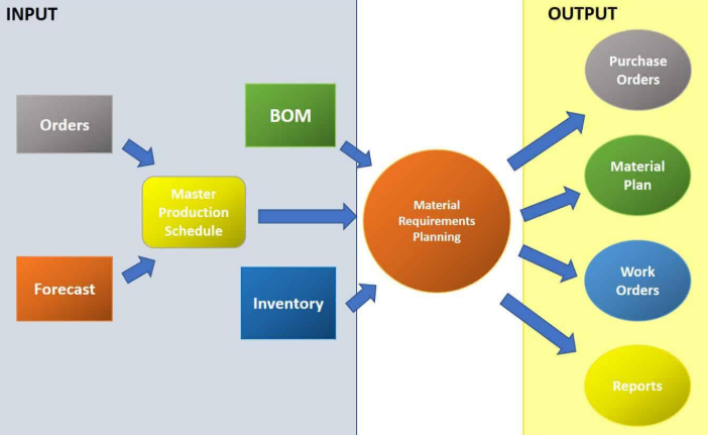
These calculations are deterministic and repeatable. Given the same inputs, the ERP system will always produce the same outputs. This reliability is one of the reasons ERP systems remain indispensable for manufacturing organizations.
However, modern supply chains face increasing uncertainty:
- Volatile customer demand
- Global supply disruptions
- Variable supplier performance
- Shortened product lifecycles
- Increasing inventory carrying costs
Traditional MRP systems were not designed to learn from changing business conditions. They execute rules but do not adapt automatically. This limitation creates opportunities for AI.
Why AI Not Replace Traditional MRP
Many discussions about AI assume that if AI can perform planning calculations faster than ERP systems, ERP systems may become obsolete. This assumption overlooks the fundamental purpose of ERP. ERP systems perform several critical functions:
- Inventory management
- Purchase order processing
- Production order management
- Financial integration
- Audit controls
- Regulatory compliance
- Master data governance
These functions require deterministic processing and complete traceability. Someone complained that the ERP calculation processing of the masses number of records (such as millions of inventory records, tens of thousands of BOMs with multi-level, multiple plants,etc) often takes hours in common ERP system. To solve this limitation, traditional calculation engines and modern in-memory databases often perform these calculations more fast, efficiently and more reliably. For instance, SAP itself introduced “MRP Live” on HANA specifically to shorten planning runs from traditional batch processing to much faster in-memory calculations. When MRP determines:
- Demand = 100 units
- Inventory On Hand = 20 units
- Open Purchase Orders = 30 units
- Net Requirement = 50 units
No machine learning or AI is required. This is straightforward business logic. AI is actually not better than a calculation engine. A modern database or ERP algorithm will usually outperform an LLM because:
- ERP calculations are deterministic
- Results must be 100% reproducible
- No hallucinations allowed
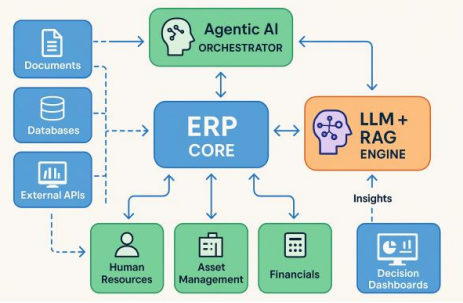
For exact net requirements calculations, AI offers little advantage. The objective of AI should not be to replace deterministic calculations. Instead, AI should improve the quality of decisions made before and after those calculations occur.
The Real Value of AI in Material Planning
AI excels in environments involving uncertainty, patterns, and prediction. The greatest value of AI lies in helping planners answer questions such as:
- Is demand permanently changing?
- Is a supplier becoming unreliable?
- Are inventory levels too high?
- Is safety stock appropriate?
- Is an alternative sourcing strategy required?
These questions require judgment rather than calculation.
AI-Driven Demand Intelligence
Demand forecasting is one of the most obvious applications of AI. Traditional forecasting methods often rely on:
- Moving averages
- Historical trends
- Statistical forecasting techniques
AI can evaluate additional variables, including:
- Customer ordering behavior
- Economic indicators
- Seasonal patterns
- Promotional activities
- Market events
For example, historical weekly demand for a product may have averaged 100 units. Recent consumption data may show:
- Week 5 = 170
- Week 6 = 180
- Week 7 = 165
- Week 8 = 175
- Average of above four weeks = 172.5 ≈ 170
Traditional planning systems may continue operating with a forecast of 100 units until a planner updates the forecast manually. An AI system may recognize that demand has structurally shifted and recommend increasing the forecast to approximately 170 units.
This capability enables organizations to respond more quickly to market changes.
AI-Driven Inventory Optimization
Inventory optimization represents one of the most valuable applications of AI. Many organizations establish safety stock levels based on historical assumptions and review them infrequently. Traditional planning parameters often remain unchanged for months or years. However, AI can continuously analyze:
- Demand variability
- Forecast accuracy
- Lead-time performance
- Inventory turnover
- Service-level achievement
For example: Current Safety Stock = 400 units. Recent analysis indicates:
- Demand increasing significantly
- Forecast error increasing
- Supplier performance unchanged
To maintain the same service level, AI may recommend increasing safety stock to 650 units. Importantly, the recommendation should be explainable as : “Demand increased from 100 units per week to 170 units per week, then AI recommended safety stock: 680 units (= 170 x 4 weeks for lead time).” Such recommendations help planners make informed decisions rather than relying on static planning parameters. In additional, as actual demand is fluctuate, the forecast error may be increased, say from 8% to 15%, while the safety stock will no longer support a 98% service level and maybe lower.
AI-Driven Supplier Performance Analysis
Traditional ERP systems typically use lead times stored in master data. For example: Supplier Lead Time = 30 Days. MRP calculations assume this value is accurate. However, actual supplier performance may differ significantly. Historical purchase-order data may reveal:
- Order 1 = 42 Days
- Order 2 = 38 Days
- Order 3 = 45 Days
- Order 4 = 40 Days
Although the ERP master record states 30 days, actual performance averages approximately 41 days. AI can continuously evaluate supplier behavior and recommend updated planning assumptions. Benefits include:
- Reduced material shortages
- Improved planning accuracy
- Better inventory positioning
- Earlier risk detection
AI-Driven Sourcing Strategy Optimization
Supplier selection is often driven by cost. However, purchase price alone does not represent total supply chain cost. Consider two suppliers:
Supplier A
- Unit Cost = £10
- Lead Time = 60 Days
- On-Time Delivery = 70%
Supplier B
- Unit Cost = £11
- Lead Time = 20 Days
- On-Time Delivery = 98%
Traditional sourcing decisions may favor Supplier A because of the lower purchase price. AI can evaluate additional factors:
- Inventory carrying costs
- Production disruption risk
- Expediting costs
- Customer service impact
- Supplier reliability
AI may conclude that a mixed sourcing strategy provides the lowest total business cost:
- 70% Supplier B
- 30% Supplier A
Such recommendations often outperform purely price-based sourcing decisions.
AI as a Planner’s Assistant
One of the most practical applications of AI is exception management. Every MRP run generates planning exceptions. Planners frequently spend hours reviewing:
- Rescheduling messages
- Shortage alerts
- Excess inventory warnings
- Supplier delays
AI can analyze:
- Historical planner decisions
- Actual business outcomes
- Inventory impacts
- Service-level impacts
The system can then recommend actions such as:
- Increase safety stock
- Delay procurement
- Expedite shipments
- Transfer inventory between sites
- Use alternative suppliers
This transforms AI into a digital planning assistant rather than a replacement for human planners.
The Future Architecture of ERP Planning
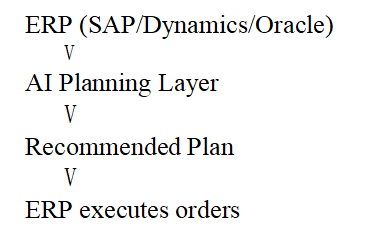
The most likely future architecture is not AI replacing ERP. The relationship is complementary rather than competitive. ERP remains the System of Record while AI becomes the System of Intelligence. ERP responsibilities:
- Transaction processing
- Inventory management
- Procurement execution
- Manufacturing execution
- Financial integration
AI responsibilities:
- Predicts demand and forecasting
- Risk prediction
- Inventory optimization
- Supplier analysis and recommends sourcing strategy
- Decision recommendations
- Planner approves exceptions
The most likely architecture is:
Conclusion
Artificial Intelligence has the potential to significantly improve material planning and supply chain performance. However, AI should not be viewed as a replacement for ERP systems. Traditional ERP platforms remain essential for deterministic calculations, transaction processing, governance, and compliance. The true value of AI lies in helping organizations make better planning decisions under uncertainty. Rather than replacing ERP systems such as SAP, Microsoft Dynamics, Oracle, or QAD, AI is likely to become an intelligent layer that enhances them.
Organizations that successfully combine ERP discipline with AI-driven decision support will be better positioned to improve service levels, reduce inventory costs, mitigate supply risks, and respond more effectively to changing market conditions. The future of material planning is therefore not ERP versus AI. It is ERP empowered by AI.
– END –